Tuesday, 14 June 2016

Liberté, égalité, fraternité - but not for women


We are interested in all things French at the moment it seems form the BBC's new block buster drama on the life of Louis XIV and Versailles to Euro 2016. France as we all know is the home of revolution, of Liberté, égalité, fraternité but what is not so well known is that women were barred from political rights even as they were being proclaimed to be universal and inalienable and in 1793 were deemed to lack sufficient education to participate in the nation's political life and by the autumn of that year they were also barred from participating in clubs and societies.

But not all Frenchmen and revolutionaries were against women's rights. Marie-Jean-Antoine-Nicolas de Caritat, Marquis de Condorcet (September 17, 1743–March 28, 1794) was one such man. In 1786 at the age forty-two, he married the twenty-two year old Sophie de Grouchy (1764–1822), with whom he forged a loving relationship. The pair shared similar political convictions and developed a solid intellectual partnership.

Like her husband, de Grouchy was committed to bringing about major judicial and political reforms in France; and her own experiences of convent schooling had left her with fierce dislike of the Church and a commitment to secular values. They both dreamed and worked towards a liberal, rational and democratic France. 
In 1790 as the French Revolution was well under way her husband called for “the admission of women to the rights of citizenship” but he was widely opposed on the grounds that women were innately inferior and destined to only to be wives and mothers.
In 1791, along with Thomas Paine, the Condorcets founded la Société républicaine [the Republican Society], sometimes credited as the first republican society in France; and Mme de Condorcet translated Paine's writings for the journal of the Society, La Républicain ou défenseur du gouvernement représentatif [The Republican or defender of representative government].
In the autumn of 1792, the Marquis was elected to the National Convention of the newly constituted first French Republic, and became chairman of the Committee on a Constitution. He proposed what became known as, “La Girondine” a constitution that was rejected in favour of the Jacobin Constitution, in June 1793 and his impassioned defence of La Girondine led to an order for his arrest and he was forced to flee from his beloved France.
Separated from one another de Condorcet wrote until he was found dead in prison cell under suspicious circumstances while his wife worked on her own text known as Lettres à Cabanis sur la sympathie [Letters to Cabanis on Sympathy], in which she sets forth her own ideas on achieving “a society of happiness” and struggles with the question of what holds society together while her own life and the life of the nation was being rent asunder as the Terror raged.
Sophie was rendered penniless by her husband's proscription and death and to support herself, her child and her sister she opened a shop and put aside her writing and translation work for years until she eventually published a translation of Adam Smith's Theory of Moral Sentiments (1759) in 1798, adding eight letters, Lettres sur la Sympathie, commenting upon this work.  This became the standard French translation for the next two centuries. Her eight letters on sympathy were however ignored by historians of economic thought, and were only recently (2008) translated into English.
In the French Revolution we see for the first time the issue of gender as a constitutional condition for the possession of political rights and it is a sad irony that the women of France would not achieve the ballot until 1944, and many of the advancements in civil law passed in the euphoria of the 1790s were withdrawn by Napoleon, and not again fully secured until the last half of the twentieth century.
The Marquis de Condorcet was symbolically re- interred in the Panthéon in 1989, in honour of the bicentennial of the French Revolution and Condorcet's role as a central figure in the Enlightenment. He started his academic life as a mathematician then transferred those skills into social and political affairs developing a model he called “social arithmetic”. He could be called the ‘father of statistics’ because he advocated the use of statistics and probability theory, to the financial reforms, the reform of hospital care, jury decision-making and voting procedures.
Sophie's contribution to modern political and economic thought is now being properly evaluated and recognised particularly in the United States where her contribution to the discussion on the nature of liberty is now being widely acknowledged. In a world of political and social turmoil she advocates that educators and social reformers should nurture 'sympathy'  the feeling for others induced by imagining yourself in another’s place and imagining how you would feel. In this way, people would be led to strive to maintain good relations with their fellows and provide the basis both for specific benevolent acts and for the general social order. 
Sympathy may be an old idea but I think its a good one and many of our politicians and economists would do well to consider it once more.
Sources:
The Status of Women in Classical Economic Thought edited by Robert William Dimand, Chris Nyland
http://plato.stanford.edu/entries/histfem-condorcet/
http://forums.philosophyforums.com/threads/rousseaus-theory-of-sentiments-57752.html
https://en.wikipedia.org/wiki/Sophie_de_Condorcet
https://en.wikipedia.org/wiki/Marquis_de_Condorcet


Sunday, 12 June 2016

Euro 2016 Liberté, Égalité, Footé

In Europe we are obsessed with all things French at the moment. No it's not because of terrorism, the Euro, fashion, the strikes or the sophistication of French culture - it's the football or more precisely the UEFA Euro 2016 Competition.

The BBC has tapped into the trend with a new multi-million pound drama, Versailles which is proving to be a hot, steamy romp of sex and violence at the court of Louis XIV and with an impressive trailer for the football with a host of commentators and sports stars dressed in 18th century costume, parading with the tricolour in hand and proclaiming - Liberte, Egalite Foote! Who says 18th century history is not relevant today?


Wednesday, 1 June 2016

June - is it the most romantic month of the year?


Tourism promoters on the Caribbean Island of Nevis have declared June the island’s Official Month of Romance. Nevis is undeniably gorgeous but where did this tradition of June romance and weddings come from? 

Let's start at the beginning - was it the Romans? 

The month of June gets its name from the Latin name for the month which was Junius which in turn is named after the Roman goddess Juno. Juno was the daughter of Saturn and sister and wife to the chief god Jupiter (the ancient immortals were prone to incest. I suppose it comes from having so few immortals to choose from!)  Juno was the patron goddess of Rome and the Roman Empire she was called Regina ("queen") and, together with Jupiter and Minerva their daughter she was worshipped on the Capitol (Juno Capitolina) in Rome. As well as being the goddess of marriage she was also the goddess who watched over the finances of the empire and her temple on the Arx (one of two Capitoline hills), was the Roman mint, so she had her hands on the purse strings too.


In ancient Rome, the period from mid-May through mid-June was considered inauspicious for marriage. Ovid says that he consulted the Flaminica Dialis, the high priestess of Jupiter, about setting a date for his daughter's wedding, and was advised to wait till after June 15. Plutarch, however, implies that the entire month of June was more favourable for weddings than May. This may have been because there are several meteor showers disturbing the heavens in May. So it seems that the Roman’s were not too keen on June weddings despite the name of the month.

Was it the Medievals?

There is a popular belief that the tradition of June brides in northern Europe began in 1500s and that it is associated with bathing. Folklore dictates that the common people took a bath once a year, in May, when the weather was warm enough for a young person to take off their clothes and wash and that with this annual grooming ritual out of the way they could get on with the business of marriage and mating.


It is certainly true that many people, especially the poor, covered their chests in goose fat and sewed themselves into their clothes for the winter in an effort to ward off the cold and diseases. They were then cut out of them in the spring when they washed, the fetid clothes were burned and new ones were put on. Which must have made anyone feel better and smell more fragrant. Of course there is no denying that a clean vest is better than a rancid one if you’re after a bit of loving but it’s hardly enough to get someone to the altar.

In her book, A General View of the Rural Economy of England, 1538-1840 (CUP, 1990), Ann Kussmaul concludes that there was no immutable season for English weddings, they happened at all times of year but having said that she goes on to identify a trend but it was not for weddings in June even though the term 'honeymoon' referred to the first moon of after the summer solstice on June 21, a term which became synonymous with 'time following the wedding.'  

Was it the weather?

It seems that our ancestors got married either in early spring before the main agricultural work of the year had begun or in the autumn when it was over. What is more it seems also that after dancing around the Maypole and having a bath our ancestors were prone to a bit of illicit frolicking in the hay. 


Over the summer months when our young ancestors were clean and fragment and they could get out into the fields and woods away from their parents’ supervision they frequently got themselves pregnant. So their romantic frolics under the summer sun and the honeyed moon led them to altar in the autumn and christenings in spring.


So perhaps June was the most romantic month. It was a time when young people discovered each other, discovered sex, formed bonds that would last the rest of their lives. Today a June a wedding is a beautiful thing whether it's in Nevis or the local Town Hall.

See my collection of 18th century inspired wedding dresses and gowns 
https://uk.pinterest.com/juliaherdman107/

Join me on Facebook 
https://www.facebook.com/julia.herdman.96


Monday, 23 May 2016

The RHS Chelsea Flower Show

Her Majesty Queen Elizabeth enjoying the show in 2014.
The annual RHS Chelsea Flower Show opened today - 23rd May 2016. The RHS patron, HM the Queen, is the guest of honour at each show and this year as she is celebrating her 90th birthday there will be special photographic exhibits and a floral arch for her.The show is so popular that tickets are restricted to four per person and are already sold out.

Chelsea is probably the world’s most famous horticultural shows and is the place to see cutting-edge garden design, find new plants and new ideas to enhance your garden. The show is held in the grounds of Royal Hospital Chelsea which was once the site of the famous 18th century Ranelagh Gardens.  

Ranelagh House and Gardens with the Rotunda (1745) T. Bowles after J. Maurer
Ranelagh was one of the great melting pots of 18th century society. Entry cost two shillings and sixpence, compared to a shilling at Vauxhall and Horace Walpole wrote soon after the gardens opened, "It has totally beat Vauxhall... You can't set your foot without treading on a Prince, or Duke of Cumberland.” Novelist Fanny Burney described how the nightly illuminations and magic lanterns ‘made me almost think I was in some enchanted castle or fairy palace’. Originally designed to appeal to wealthier tastes, pleasure gardens soon became the haunt of the rich and poor alike. 

Actress Gwyneth Paltrow at the show.
When it first opened in 1746, Ranelagh boasted acres of formal gardens with long sweeping avenues, down which pedestrians strolled together on balmy summer evenings. Other visitors came to admire the Chinese Pavillion or watch the fountain of mirrors and attend musical concerts held in the great 200-foot wide Rotunda, the gardens' main attraction where Mozart performed as a child.  Yet the novelty soon waned. In June of that year Catherine Talbot wrote to a friend that “…it is quite vexatious at present to see all the pomp and splendour of a Roman amphitheatre devoted to no better use than a twelvepenny entertainment of cold ham and chicken.” And Ranelagh soon lost out to the cheaper and more exciting Vauxhall Gardens. It probably didn’t help that the Rotunda proved to have dreadful acoustics, there was no drinking or gambling allowed and the grounds were too well lit for assignations.

Canaletto. The Interior of the Rotunda at Ranelagh (c1751).
However Ranelagh remained open for sixty years weathering the storms and frosts of the 1780s, London riots and the French wars until 1803.

The RHS Chelsea Flower Show is organised by the Royal Horticultural Society which was founded in 1804. Today the Great Pavilion is one of main attractions covering roughly 11,775 square metres or 2.90 acres, enough room to park 500 London buses.

Actor Benedict Cumberbatch with his mother actress Wander Ventham in the Great Pavillion.
This year we can expect 2016 there will be spectacular show gardens, showcasing the exceptional talent of a handful of carefully selected garden designers. Alongside the Show Gardens are the smaller garden categories. The Artisan Gardens pay homage to traditional and contemporary artisan skills, and the Fresh Gardens category incorporate innovative materials and challenging ideas. There will be unique products for the garden and home including limited edition sculptures and gardening essentials, and in Ranelagh Gardens five artisans have been invited to dress Studios in which they will exhibit their handmade crafts.

Thursday, 5 May 2016

Imagining life without antibiotics

Mary Woolstonecraft, author of the Vindication of the Rights of Women fell victim to Childbed fever in 1797 having given birth to her daughter Mary Shelly the author of Frankenstein

The discovery of antibiotics has transformed all of our lives but it was found quite by accident when Professor Alexander Fleming discovered that one of the plates which had previously been coated with staphyloccus bacteria had mould on it in 1928. The mould was penicillium notatum but it was not used on a human being until 1941 when an Oxford doctor, Charles Fletcher, tried it on a patient dying from an infected wound. The patient unfortunately died, not because the drug did not work but simply because Fletcher did not have enough to kill all the bacteria. Having proved its effectiveness in reducing bacterial infection in people the drug went into production and was available to treat patients from the end of World War II. In 1945 Fleming, and the US drug company that manufactured the new ‘Wonder Drug’ Chain and Florey were awarded the Nobel Prize for Medicine.
Staphylococcus has many strains and causes a wide variety of diseases in humans and animals. About 20% people are long-term carriers of staphyloccus  aureus on the skin or in the nostrils and it lurks quite inertly in the healthy lower reproductive tract of women. It can cause a range of illnesses, from minor skin infections, such as pimples, impetigo, boils, cellulitis, folliculitis, carbuncles, scalded skin syndrome, and abscesses, to life-threatening diseases such as pneumonia, meningitis, osteomyelitis, endocarditis, toxic shock syndrome, bacteremia, and sepsis. It is still one of the five most common causes of hospital-acquired infections. When it gets into the bloodstream your chances of surviving without antibiotics is about 20% for a healthy adult for the frail and the very young it is much lower so it is not surprising that many people in the past died of what we consider to be relatively minor illnesses e.g.:infected wounds, rotten teeth, septic throats, leg ulcers and abscesses.
Puerperal or childbed fever was a common infection in the past. It is an infection of the uterus and surrounding tissues. Infection can be caused by a number of factors: premature rupture of membranes, vaginal examinations, manual removal of the placenta, and prolonged labour. In chapter II of 'Feavers and Acute Diseases in Women in Childbed' Nicholas Culpepper discusses puerperal fever (though not by this name) and attributes it to the “…stoppage of the afterflux… or the foul humours that were gathered at the time of being with child and stirred in travel” i.e. labour. In addition to this, getting up too soon after childbirth, too rapid a delivery, changes in the weather, strong drink, spices, metastasizing milk, and obstructed perspiration were all suggested as possible causes but the most popular was that it arose from poisons in the atmosphere or miasma.
The epidemic of childbed fever that struck the city of Aberdeen, Scotland, between December 1789 and March 1792 was unusual. It occurred not in the dirty, crowded and ill-ventilated wards of lying-in hospitals, but throughout the city and surrounding villages. Alexander Gordon, physician to the Aberdeen Dispensary found that "this disease seized such women only as were visited or delivered by a practitioner or taken care of by a nurse who had previously attended patients affected by the disease."  He admitted, "I myself was the means of carrying the infection to a great number of women." He went on to recommend in his report of 1795 that, "Nurses and physicians who have attended patients afflicted with the puerperal fever ought carefully to wash themselves and get their apparel properly fumigated before it be put on again." Unfortunately his advice was rejected by the medical establishment of the time, he died a broken man a few years later and the carnage in the the lying-in wards continued unabated.
One famous victim of puerperal fever was Mary Wollstonecraft, mother of Frankenstein author Mary Shelley. In 1797 she gave birth to her daughter Mary with the assistance of a midwife but then a doctor was called to help remove the placenta. He came quickly and with unwashed hands removed it. Wollstonecraft died a painful but typical death a week later. Today, as I know myself these infections are treated with antibiotics. Antibiotics saved my life twice in childbirth so I am very grateful that I was born after their discovery.
In the 1790s, Gordon stressed that the disease was spread from one patient to another. In 1842, Thomas Watson recommended that physicians and birth attendants wash their hands and use chlorine between patients. In 1847, Ignaz Semmelweis reduced the rate of fever in his obstetric ward by ordering hand washing, but the idea was still rejected by the medical industry at large and it was not until the late 1850s when the work of Louis Pasteur and Robert Koch provided convincing evidence of what we now call 'germ theory' that the idea of human transmission of infection started to be accepted. Indeed in 1880 the miasma theory was still competing with the germ theory of disease. Eventually, a "golden era" of bacteriology ensued, in which the theory quickly led to the identification of the actual organisms that cause many diseases.
Antibiotics are precious and we should use them wisely. If we look at what life was like before we had them I am sure we would not take them for granted.
Find me on:
https://www.facebook.com/julia.herdman.96
https://uk.pinterest.com/juliaherdman107/
References:
Porter  Ian A. Alexander Gordon MD of Aberdeen 1752-1799.  University of Aberdeen:Oliver and Boyd (Edinburgh), 1958.
Gordon, Alexander. A Treatise on the Epidemic of Puerperal Fever of Aberdeen.London:GG and J Robinson,1795.
A Directory of Midwives or a Guide for Women” by Nicholas Culpepper (London, 1681).


Sunday, 1 May 2016

What should a respectable widow wear?

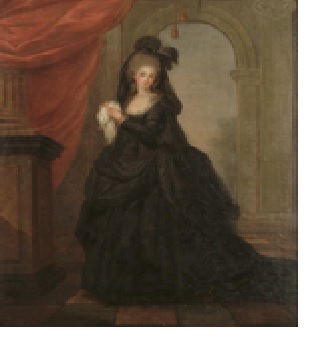
By the late 19th century, mourning behaviour in England had developed into a complex set of rules, particularly among the upper classes. For women, the customs involved wearing heavy, concealing, black clothing, and the use of heavy veils of black crêpe. The entire ensemble was colloquially known as "widow's weeds" (from the Old English waed, meaning "garment").

The growing wealth of the eighteenth century aristocracy set the trend for the flamboyant expression of loss and grief with masses of black bombazine silk, ostrich feathers and bows.


But older and poorer women choose a much simpler, more practical styles and with the growth of the urban middle class, particularly in Britain the demand for dull, black, mourning wools, black and white silk crepe increased as incomes and social expectations rose.


Black however was not the only acceptable colour for grief. In the portrait below we see a woman holding a portrait of her dead husband wearing white with a black lace collar and bonnet. Mauve was also an acceptable colour. 

The wearing of mourning clothes was more of a social necessity for women than men. Whilst men might wear a special suit of sombre clothing for the actual funeral they were rarely expected to wear special clothes or colours unlike women who were expected to show the world their change in status for at least a year and a day.

Of course many women wanted show respect to their dead husbands and continued to wear sombre colours for the rest of their lives. Indeed Charlotte Leadam the heroine of my first novel Sinclair is a young widow and faces this very problem.  As she waits for her husband's creditors to present their accounts, she is, "wearing her new mourning clothes; a respectable but uncomplicated widow's cap and a full length black cloak both in black bombazine silk. The silk was not shiny like taffeta but had a sombre, matte finish that seemed to drain the colour from her face making her look even more wan and tired than she actually was."

"Wearing black crepe was the only acceptable thing to do for a woman in her position and she would have to wear it in public for a minimum period of one year and one day. After that she could choose wear subdued colours such as browns and greys, purples, lilacs, lavenders, and even white."

"But today was the first time that she had appeared in her widow's clothes in public and by this act she was acknowledging that her life had changed forever. It was a sign to the world that she was respecting her husband’s memory but it also told anyone who was interested that she was irreparably damaged, that she was half spent or half dead inside and that she was lonely and vulnerable. To wear anything else would indicate that she was a heartless harlot but she hated the loathsome colour; it reminded her of her loss and it told the world that she was alone.”

In a world where a woman became her husband’s property on marriage and where a middle class widow could not enter the professions to support herself signalling this change in marital status could have its advantages showing men that they were available for marriage again.

Julia Herdman’s debut novel Sinclair will be available later this year.


Julia Herdman’s debut novel Sinclair will be available later this year.

Some thoughts on May Day

When I think of May Day I think either of Maypoles, Morris Dancing and the Jack in the Green or the old Soviet military processions in Red Square.


Of course the origins of May Day stretch back into the mists of time. In the late Middle Ages people in England started to dance around a Maypole (a pole with no ribbons) as a celebration of Spring and to encourage fertility in the soil and people. This was banned by the Puritans but came back with the Restoration in 1660 and has remained with ever since – the Victorians added the ribbons. 


But by the seventeenth century England was on the long march to modernity and urban living and London was well on the way to being the first great modern city in the world so May Day in London had nothing to do with May Poles or flowers.

May Day was one of a number of days of the year; Shrove Tuesday, Ascension Day, Midsummer and St Bartholomew’s Day; when disorder reigned.  Between 1603 and 1642 Shrove Tuesday riots involved apprentice boys attacking brothels, bawdy houses and playhouses to reduce temptation during Lent! In the same period there were eight May Day riots. The attacks on bawdy houses seem to peter out after the Restoration and the nature of May Day and other celebration days changes again.


In the late seventeenth century there is evidence of what are called ‘ridings’ in London and other towns. In a ‘riding’ those who are viewed to have transgressed the sexual morality of the day were harangued in the street by the mod beating their pots and pans and shouting at the tops of their voices in what was called ‘rough music.’ In June 1664 a woman appeared before a magistrate in Middlesex accused of following a woman down the street shouting, ‘whore, whore’ and clapping her hands. She was joined by others and soon there was a near riot. Those deemed to have offended their community were spat on, had dirt and stones thrown at them as well as the contents of chamber pots. In London haranguing husbands who had beaten or cheated on their wives was particularly popular as was terrorising brothel keepers and the mothers of illegitimate children.


Historian Charles Pythian-Adams has argued that during the eighteenth century May Day celebrations in London were transformed becoming socially segregated with the rich withdrawing from popular or plebeian activities, but this notion leaves out the growing urban middle class and the effects of growing religious non-conformity. As the eighteenth century progressed so did social separation (both class and gender) but it was not exclusively the elites separating themselves from the poor, the middle class were able to buy their way into urban elite culture, they may not have had a box at the theatre but they could have a seat in the stalls; and as for the poor they separated into those who chose the strictures of religious non-conformity (no pagan rituals) over the perceived laxity of the established church(pagan rituals accepted). This new urban culture was not conducive to what we think of as May Day traditions and its celebration or marking lapsed until it was re-invented and sanitised by the Victorians who gave us children holding ribbons and dancing round the May Pole in the Board School yard.


Source: The Eighteenth-Century Town: A Reader in English Urban History 1688-1820, By Peter Borsay, Routledge 2013